
V. ABOVE Design for Textile by Gunta Stölzl (Germany). Gunta Stölzl Archive, Works – Bauhaus Dessau 1925–1931.
V. ABOVE: Design for Textile by Gunta Stölzl (Germany).
Gunta Stölzl Archive, Works – Bauhaus Dessau 1925–1931.


II.
LEFT Textile, 5 Chöre, 1928
by Gunta Stölzl (Germany).
III.
BELOW The African Chair, designed in 1921 by Gunta Stölzl and Marcel Breuer. Image of Bauhaus-Archiv Berlin. Photo: Hartwig Klappert.
IV.
LAST Textile sample by
Gunta Stölzl (Germany). The Museum of Modern Art, New York.

Textile Teachers:
Trude Guermonprez
Textile Teachers:
Trude Guermonprez
Visual Studies 08
Trude Guermonprez was a German-born weaver and teacher who taught in the United States, at Black Mountain College in North Carolina and California College of Arts and Crafts in Oakland, where she became chair of the crafts department in 1960. She is well known for her three-dimensional space hangings and woven tapestries, combining traditional weaving techniques with an experimental approach to open structures, unusual materials and sculptural forms.

mohair
The mohair blanket is a soft, voluminous blanket with a welcoming tactility, hand-woven using the finest mohair with added wool for greater body and increased longevity. Our Artisans follow centuries-old tradition working the Angora fibres into superlatively soft blankets. Smooth and lustrous in texture, each is breathable and lightweight, crease - resistant and kind to sensitive skin.
As a naturally renewable resource needing no chemical treatment, mohair goes gently on the earth in its production while providing strength and resilience when spun into yarn.
newsletter
mohair
The mohair blanket is a soft, voluminous blanket with a welcoming tactility, hand-woven using the finest mohair with added wool for greater body and increased longevity. Our Artisans follow centuries-old tradition working the Angora fibres into superlatively soft blankets. Smooth and lustrous in texture, each is breathable and lightweight, crease - resistant and kind to sensitive skin.
As a naturally renewable resource needing no chemical treatment, mohair goes gently on the earth in its production while providing strength and resilience when spun into yarn.
newsletter

ABOVE: Portrait of Gunta Stölzl. c.1927–1928.
From Bauhaus-Archiv Berlin
Born in 1910, Guermonprez studied weaving in Halle under Bauhaus-trained Benita Otte, before continuing her training in Sweden and Finland. In the 1930s she settled in the Netherlands, began working at the hand-weaving studio Het Paapje, and married photographer Paul Guermonprez, who was executed in 1944 for his involvement in the Dutch Resistance.
Born in 1910, Guermonprez studied weaving in Halle under Bauhaus-trained Benita Otte, before continuing her training in Sweden and Finland. In the 1930s she settled in the Netherlands, began working at the hand-weaving studio Het Paapje, and married photographer Paul Guermonprez, who was executed in 1944 for his involvement in the Dutch Resistance.
VI.
RIGHT Weaving by Gunta Stölzl (Germany). Collection of The Museum of Modern Art, New York.
VII.
BELOW Gunta Stölzl in the Bauhaus weaving workshop, c.1928.
Photo: unknown.
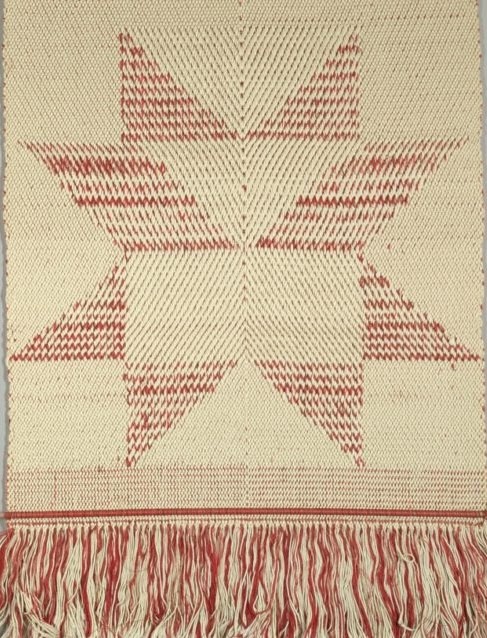


II.
ABOVE Textile, 5 Chöre, 1928
by Gunta Stölzl (Germany).
III.
ABOVE Textile sample by
Gunta Stölzl (Germany). The Museum of Modern Art, New York.
IV.
BELOW The African Chair, designed in 1921 by Gunta Stölzl and Marcel Breuer. Image of Bauhaus-Archiv Berlin. Photo: Hartwig Klappert.

Born in 1910, Guermonprez studied weaving in Halle under Bauhaus-trained Benita Otte, before continuing her training in Sweden and Finland. In the 1930s she settled in the Netherlands, began working at the hand-weaving studio Het Paapje, and married photographer Paul Guermonprez, who was executed in 1944 for his involvement in the Dutch Resistance.

ABOVE: Portrait of Gunta Stölzl. c.1927–1928.
From Bauhaus-Archiv Berlin
ABOVE: Portrait of Gunta Stölzl. c.1927–1928.
From Bauhaus-Archiv Berlin
Born in 1910, Guermonprez studied weaving in Halle under Bauhaus-trained Benita Otte, before continuing her training in Sweden and Finland. In the 1930s she settled in the Netherlands, began working at the hand-weaving studio Het Paapje, and married photographer Paul Guermonprez, who was executed in 1944 for his involvement in the Dutch Resistance.
ABOVE: Portrait of Gunta Stölzl. c.1927–1928.
From Bauhaus-Archiv Berlin
Combining technical knowledge and creative experimentation, she encouraged her students to push the boundaries of traditional weaving beyond its traditional forms exploring new materials, techniques and ways of constructing cloth. Among her students was Kay Sekimachi, who she taught double weaving and encouraged to experiment with the structure of the loom, and contributed to the development of Sekimachi's well known layered, sculptural textiles.
Combining technical knowledge and creative experimentation, she encouraged her students to push the boundaries of traditional weaving beyond its traditional forms exploring new materials, techniques and ways of constructing cloth. Among her students was Kay Sekimachi, who she taught double weaving and encouraged to experiment with the structure of the loom, and contributed to the development of Sekimachi's well known layered, sculptural textiles.
Combining technical knowledge and creative experimentation, she encouraged her students to push the boundaries of traditional weaving beyond its traditional forms exploring new materials, techniques and ways of constructing cloth. Among her students was Kay Sekimachi, who she taught double weaving and encouraged to experiment with the structure of the loom, and contributed to the development of Sekimachi's well known layered, sculptural textiles.
Combining technical knowledge and creative experimentation, she encouraged her students to push the boundaries of traditional weaving beyond its traditional forms exploring new materials, techniques and ways of constructing cloth. Among her students was Kay Sekimachi, who she taught double weaving and encouraged to experiment with the structure of the loom, and contributed to the development of Sekimachi's well known layered, sculptural textiles.
II.
LEFT Textile, 5 Chöre, 1928
by Gunta Stölzl (Germany).
III.
BELOW The African Chair, designed in 1921 by Gunta Stölzl and Marcel Breuer. Image of Bauhaus-Archiv Berlin. Photo: Hartwig Klappert.
IV.
LAST Textile sample by
Gunta Stölzl (Germany). The Museum of Modern Art, New York.
V. ABOVE Design for Textile by Gunta Stölzl (Germany).
Gunta Stölzl Archive, Works – Bauhaus Dessau 1925–1931.
mohair
The mohair blanket is a soft, voluminous blanket with a welcoming tactility, hand-woven using the finest mohair with added wool for greater body and increased longevity. Our Artisans follow centuries-old tradition working the Angora fibres into superlatively soft blankets. Smooth and lustrous in texture, each is breathable and lightweight, crease - resistant and kind to sensitive skin.
As a naturally renewable resource needing no chemical treatment, mohair goes gently on the earth in its production while providing strength and resilience when spun into yarn.
newsletter
VI.
RIGHT Weaving by Gunta Stölzl (Germany). Collection of The Museum of Modern Art, New York.
VII.
BELOW Gunta Stölzl in the Bauhaus weaving workshop, c.1928.
Photo: unknown.
Between 1961 and 1965, Guermonprez developed a series of three-dimensional space hangings, leaving sections of the warp unwoven so light could pass through the exposed threads. Her later work became more personal, incorporating text and narrative into the weave, including a curtain for the Torah ark at Beth Am Synagogue in California, with Hebrew lettering woven directly into a sheer cloth.
Between 1961 and 1965, Guermonprez developed a series of three-dimensional space hangings, leaving sections of the warp unwoven so light could pass through the exposed threads. Her later work became more personal, incorporating text and narrative into the weave, including a curtain for the Torah ark at Beth Am Synagogue in California, with Hebrew lettering woven directly into a sheer cloth.
Between 1961 and 1965, Guermonprez developed a series of three-dimensional space hangings, leaving sections of the warp unwoven so light could pass through the exposed threads. Her later work became more personal, incorporating text and narrative into the weave, including a curtain for the Torah ark at Beth Am Synagogue in California, with Hebrew lettering woven directly into a sheer cloth.
Between 1961 and 1965, Guermonprez developed a series of three-dimensional space hangings, leaving sections of the warp unwoven so light could pass through the exposed threads. Her later work became more personal, incorporating text and narrative into the weave, including a curtain for the Torah ark at Beth Am Synagogue in California, with Hebrew lettering woven directly into a sheer cloth.
VI.
RIGHT Weaving by Gunta Stölzl (Germany). Collection of The Museum of Modern Art, New York.
VII.
BELOW Gunta Stölzl in the Bauhaus weaving workshop, c.1928.
Photo: unknown.